
Fields in Lamar County Property Tax
Lamar County splits this into two linked public views. The appraisal card identifies the parcel and lists the values used to build the tax roll. The bill-side record appears in the real-property tax search. Reading both keeps a payment figure from being mistaken for a value, or an owner line from being treated as a deed.
| Field | What It Shows | Where |
|---|---|---|
| Owner and parcel keys | Name, address, parcel number, and PPIN | Appraisal and tax searches |
| True or appraised value | Assessor's estimate of fair market value | Real Property Appraisal |
| Assessed value | Statutory share of true value used in the tax formula | Assessment roll |
| Exemption | Qualified relief applied through the assessor | Homestead record |
| Bill and payment status | Amount billed, paid, or delinquent | Tax Collector search |
Mississippi does not tax full true value. Instead it applies assessment ratios. Class I owner-occupied residential property is assessed at 10 percent of true value, while Class II other real property sits at 15 percent. Millage then applies to the assessed amount. Any lawful exemption reduces the taxable result, and a sale price stays out of the picture entirely, since it belongs to the recorded deed trail.
Lamar County Tax Roll Calendar
The year starts on January 1. Values, exemptions, and the lien take effect that day. Homestead applications face an April 1 deadline. So do several other property filings. The roll reaches the Board of Supervisors on the first Monday in July, and public inspection plus the valuation-notice protest period follow in late July before the first Monday in August.
Real property must be reappraised at least once in each four-year cycle. That cycle is not a live feed. The portal warns that uploads may lag behind courthouse activity. Values stay tied to the effective date. For a year-end sale or new construction, compare the record date, the tax year, and the appraisal status before relying on any figure.
The county appraisal page shows the effective date and protest timing:

Knowing the schedule tells a taxpayer which year's snapshot is on the table. It marks when the roll opens for objections.
Search Lamar County Tax Records
The Lamar real-property tax lookup takes more than one key. PPIN or parcel number works best. Those identifiers sidestep spelling and postal-address mismatches. Name and address searches still help when the number is unknown, and rural parcels can be narrowed by section, township, and range.
| Field | Best use | Check before relying |
|---|---|---|
| Owner name | Find all likely accounts for a person or entity | Try spacing, initials, trusts, and business names |
| Address | Locate a known site | Distinguish situs from mailing address |
| Parcel number | Open a known tax parcel | Copy it from the current card |
| PPIN | Cross-reference appraisal, tax, and land records | Preserve all digits |
| Section, township, range | Find rural land without a stable street label | Match the legal description |
The captured search screen confirms those routes:
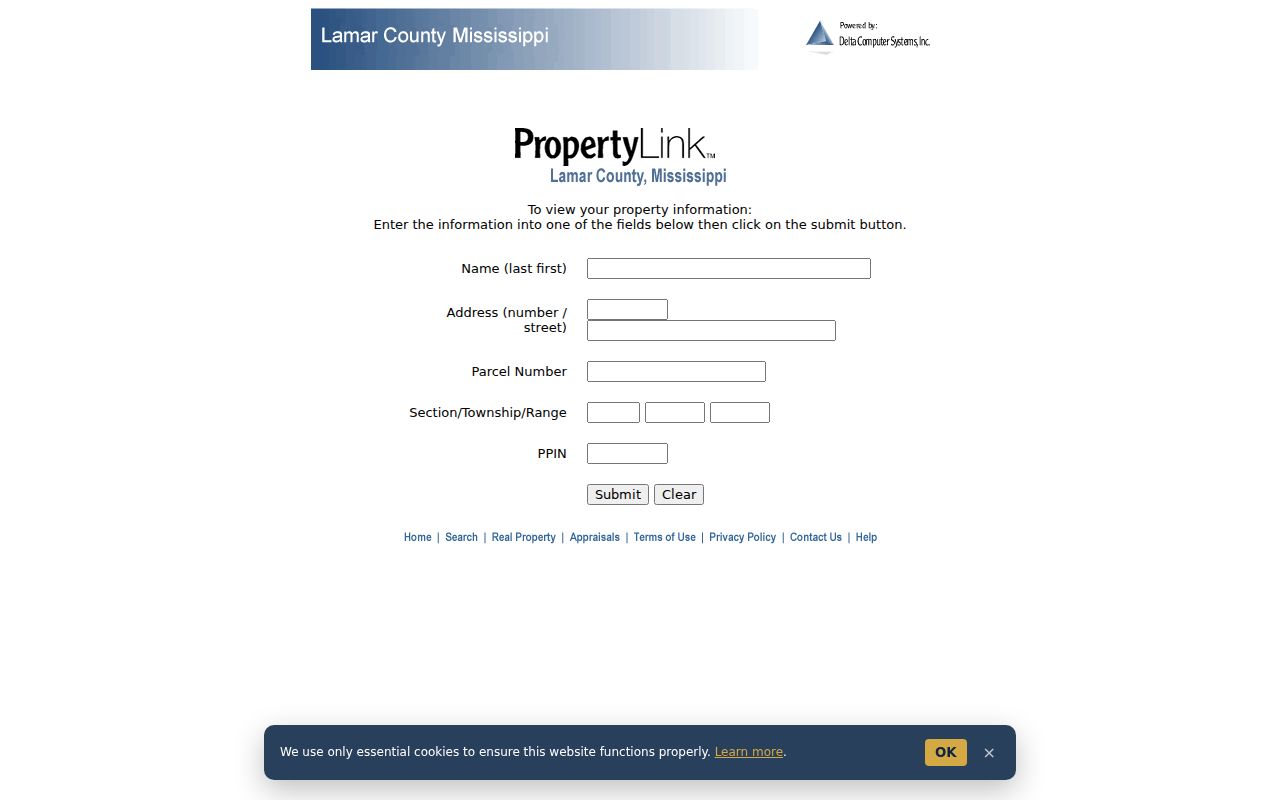
Match any result to the appraisal card first. Then use bill status, exemption, or owner information in a dispute or payment decision.
Open a Lamar County Tax Bill
Opening a Lamar County tax bill works best as a short comparison between the collector's bill and the assessor's parcel card. Identity comes first. Value and relief come second. After that, follow the payment trail from billing through posting, which keeps a same-name owner or a nearby lot from being applied to the wrong parcel.
- Search the Delta real-property tax system by PPIN, parcel, name, address, or land description.
- Match the owner, situs, and parcel keys to the Real Property Appraisal card.
- Read the tax year, amount, and payment status. Keep a copy or receipt reference for any payment issue.
- Check exemptions and assessed value on the appraisal side, then contact the correct assessor or collector desk for a mismatch.
- Assessed value
- The statutory percentage of true value used in the tax calculation.
- Millage or levy
- The rate applied by the taxing authorities to assessed value.
- Homestead exemption
- Qualified tax relief tied to an eligible owner's home.
- Tax lien
- The public claim created by unpaid property tax.
Lamar County Property Tax Due Dates
February 1 is the big day. Lamar County real-property taxes paid by then earn no interest, and a half percent per month starts February 2. An assessor/collector page lists January 31 instead, so trust the tax page's February schedule when you write payment copy, and confirm the current deadline with the Collector before you pay.
Payments are easy to make. You can pay online, by mail, or in person. Visit the Tax Collector at 144 Shelby Speights Drive in Purvis, or mail to P.O. Box 309, Purvis, MS 39475. For payment or delinquency questions, call 601-794-1020. For appraisal or exemption questions, call the Assessor at 601-794-1021.
The official tax page shows the payment and delinquency schedule:

Go with the date shown for the relevant tax year. It controls over an undated summary or a third-party reminder.
Lamar County Homestead Records
Homestead applications live with the Tax Assessor/Collector. County duties also place homestead assistance with the Chancery Clerk during equalization. The county's application deadline is April 1. An exemption changes the tax outcome, not the deed. Its presence supports occupancy and eligibility for a tax year without proving title.
Compare the exemption year, owner line, mailing address, and situs. Ask the assessor what proof a new or changed filing needs. Mississippi Department of Revenue guidance sets the state framework. The county processes the local application and the roll entry.
Note: A homestead entry can support a tax review. But the latest recorded deed remains the ownership instrument.
Lamar County Delinquent Tax Trail
Unpaid taxes open a separate trail. The Collector advertises the delinquency. A $3 publication fee applies on August 1, and the lien is auctioned on the last Monday in August through the stated GovEase process. The Chancery Clerk holds sale and redemption records. Search the bill, the annual notice, the sale record, the redemption record, and any later tax deed as distinct steps.
The county's 2026 tax-sale notice page links the dated publication:

A published balance never proves title passed. Redemption or a later deed can change the result.
Tax Districts Across Lamar County
A Sumrall, Purvis, or Lumberton mailing address is not proof of tax jurisdiction. The postal city is only one layer. The incorporated boundary, the school area, and the county can all point in different directions. Lumberton, in fact, straddles both Lamar and Pearl River counties. So match the parcel to the right county roll and taxing districts. Don't guess from the address line.
To check the value side, compare the parcel's class and true-value fields. Then read the district and bill data tied to the same PPIN. County planning and map sources can clarify jurisdiction. But only the official tax record governs the billed account. For the broader number meanings, see the Lamar County property value explanation.
Contest a Lamar County Assessment
Dispute a value? Start with the basics at Real Property Appraisal. Check the parcel facts, land and improvement details, classification, and exemption record. Strong evidence speaks to the January 1 value. That means correct measurements and condition facts. It also means a survey where land area is wrong, comparable sales, and documents showing an error on the county card.
The roll reaches the Board of Supervisors on the first Monday in July. Public inspection and protests run the last two weeks of July, ahead of the first Monday in August. Ask early for hearing and filing instructions so you meet the current-year calendar. Keep two requests straight. A tax-payment dispute and an appraisal protest are not the same thing. Each belongs at a different desk.
Begin with the appraisal card itself. Confirm the land size, building data, use class, exemption status, and parcel identity as listed. The county's appraisal page sets values effective January 1, so tie your evidence to that date. Dated photographs carry weight. So does a survey when acreage is disputed. Repair records bearing on condition and sales of truly comparable property matter too. The Assessor can explain local filing steps. The Board of Supervisors hears the roll objection on the county's own timetable.
A later tax bill will not reopen valuation on its own. Nor does paying a bill fix a wrong owner name, a parcel split, or a missing exemption. Route ownership evidence to the Assessor, payment proof to the Collector, and recorded conveyances to the Chancery Clerk. Web systems sometimes disagree. Save each result with its retrieval date. Ask which annual roll or posting cycle it reflects. That paper trail separates a genuine error from ordinary timing gaps between county systems.
The protest window is short. Lamar County opens roll inspection and valuation protests late in July before the first Monday in August. Confirm the exact current deadline with the Assessor.