
Trace Lamar County Former Owners
Build the timeline in reverse. Each row below stands for a deed tied to one tract, not real owners. The method preserves every control, from book and page to legal description, so the next search can be checked against the same Lamar County land. Copy the land before trusting the name.
| Transfer date | Grantor to grantee | Deed type | Book/page |
|---|---|---|---|
| Newest confirmed filing | Prior owner to current grantee | Exact indexed type | Current citation |
| Next older filing | Earlier owner to that prior owner | Exact indexed type | Earlier citation |
| Earlier linked filing | Continue one owner back | Exact indexed type | Earlier citation |
| Archive-era filing | Match the same tract in the old index | Deed-book entry | Volume and page |
Trust the recording date over anyone's memory of a sale. Treat consideration as a clue only. A price can reflect a family transfer rather than a market sale. Corrections, life-estate deeds, executor's deeds, tax deeds, and trustee's deeds all explain why a former owners trail may look nothing like a simple buyer-seller sequence in the deed records.
Start with Lamar's Current Grantee
The Delta appraisal roll can open the trail. It lists the present owner line, situs, mailing address, parcel number, and PPIN. Treat those fields as a starting candidate only, since the roll can lag a newly recorded deed. Confirm the owner in the Lamar County Chancery land index with that name as grantee and the subject land as control.
A portal result can show instrument number, book and page, filing date, deed type, from and to parties, consideration, parcel fields, legal description, related instruments, and an image control. Copy the prior grantor from the newest confirmed transfer. That name becomes your next grantee search. Set an earlier date span and run it again.
The live land-record search shows the name and instrument controls used for the first backward step into Lamar County deed records. Each control is a thread worth pulling.
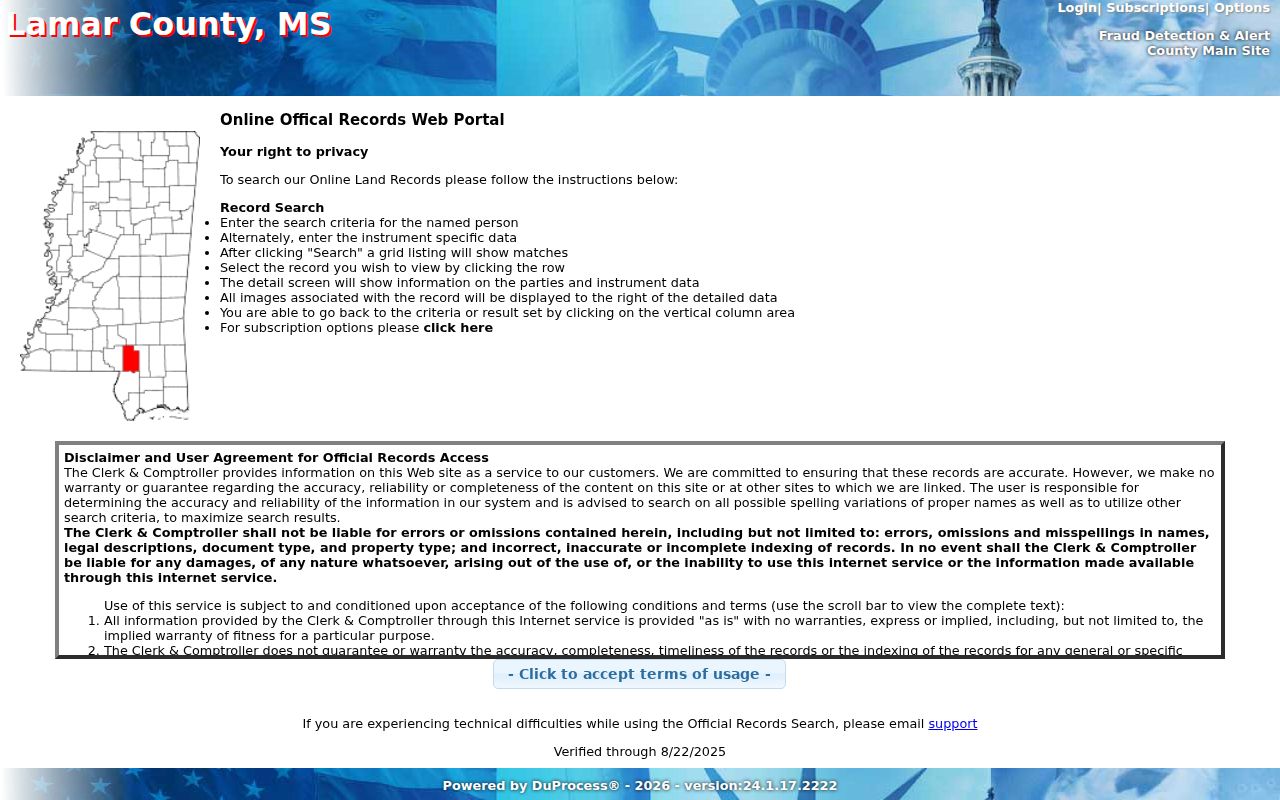
Record the exact indexed spelling from each row first. Then turn the prior grantor into the next grantee search. Note: A current tax-roll name starts the inquiry; the newest matching recorded deed starts the defensible backward chain.
Reconstruct Lamar County Prior Owners
Each known owner becomes a search key. That is the reverse-index workflow. Stay with one tract, since names repeat across Lamar County and a former owner in the property records may have held several parcels.
- Open the newest deed that matches the subject's legal description. Enter its date, parties, type, and citation in the first timeline row.
- Take that deed's grantor and search the earlier index with the person or entity as grantee.
- Compare legal description, parcel fields, subdivision, lot, block, section, township, and range. Reject same-name results for other land.
- Repeat until the web results stop, then carry the last confirmed citation into courthouse books and archive film.
- Grantor
- The party who conveyed the interest in that instrument.
- Grantee
- The party who received the interest in that instrument.
- Chain of title
- The connected sequence of recorded land interests.
- Reverse index
- An index used to trace recipients and their earlier acquisitions.
- Quitclaim and warranty deed
- Different conveyance forms whose promises differ; either can be a chain link.
When Lamar Owner Names Drift
The portal offers Grantor, Grantee, Search All, Matched Name, and Full Name fields. Its full-name hint reads surname first. Try initials, spacing, former surnames, trusts, and business names. Never accept a result until the land matches. An LLC can also be checked in the Mississippi Secretary of State business search to clarify the indexed entity name.
Estate transfers can break a name-only trail. Look for administrator's deeds, executor's deeds, wills, death affidavits, heirship affidavits, chancery cases, and related instruments. MDAH lists partial Lamar will records for 1901 through 1925 on roll 12980. Probate evidence explains authority. The deed still carries the land transfer in the chain.
Keep Lamar's Land Description Thread
Addresses make poor long-term anchors. E-911 numbers and postal labels serve current uses. Older deeds may carry no street number at all. Copy every land word. Pull subdivision, phase, lot, block, section, township, range, quarters, and boundary wording from each link. The Chancery portal exposes dedicated fields for each of those search paths.
A parcel split can create a new tax parcel without erasing the old deed description. Plat vacations and new phase plats do the same. Follow related deeds, releases, surveys, and plats. That shows when the land itself changed, not that the former owners trail broke.
Lamar's Online Cutoff Is Unstated
Lamar County's web form opens with a Begin Date already set to 1/1/1800. That figure is just an input, not a promise. Nothing on the site says every deed from that date has been indexed or digitized. An empty results screen proves little. A very old deed can sit in a book the county has never scanned. An indexed row is no guarantee either. The image behind it may not be online.
So when an online chain of prior owners runs dry, take the details to the Chincery Clerk at 403 Main Street in Purvis. Carry the last known party, recording date, book and page, and legal description. The courthouse index there is the official record. The office keeps weekday hours of 8 a.m. to 5 p.m. Mail goes to P.O. Box 247, Purvis, MS 39475, and the phone number is 601-794-8504.
Do not treat 1800 as coverage. The Lamar County portal publishes no verified online cutoff; older former owners may require courthouse books and MDAH microfilm.
Marion Records Bridge Lamar Ownership
Lamar County was created from Marion County in 1904. Any tract owned before that year may sit in Marion's deed books, since the archive trail runs through Marion first. The MDAH Lamar County microfilm finding aid shows deed books transcribed from Marion County, volume 1, covering 1836 through 1886 with a separate index. A second index covers the deed books spanning 1836 through 1903. Both sit on roll 12979.
The catalog view preserves the exact run.
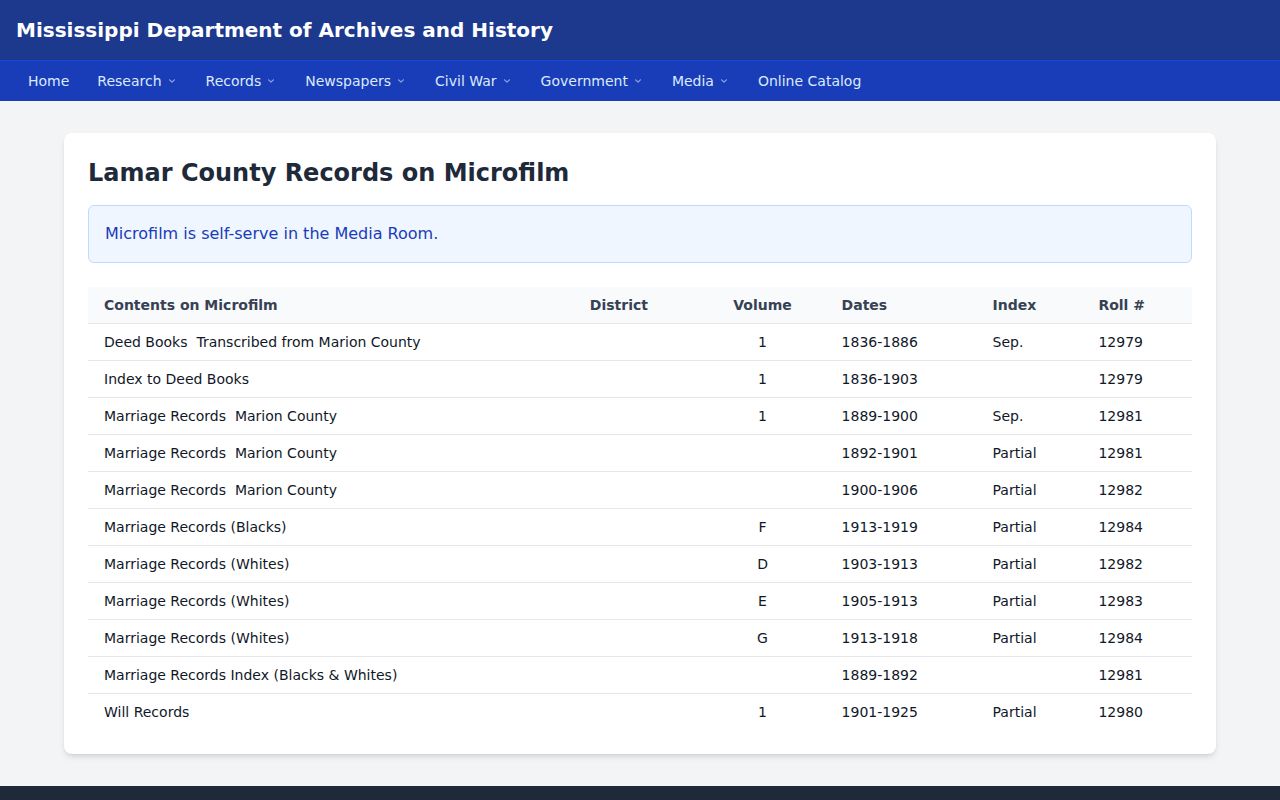
MDAH keeps the film self-serve in its Media Room, and it does not circulate on loan. Use the finding aid for title, date, volume, and roll. The archive listing never replaces the original deed record itself.
Lamar County Chain Research Inventory
A clean working file makes gaps visible. For every transfer, preserve enough facts to repeat the search and prove the entry concerns the same parcel. The official portal supplies the core fields. An image can add signatures, acknowledgments, exhibits, and the full legal description.
- Instrument number, book and page, filing date, and exact instrument type
- All from parties and to parties, including entity or estate capacity
- Parcel ID, Parcel Num, PPIN, subdivision, lot, block, and rural land calls
- Consideration, page count, document status, and related instruments
- Source image or certified-copy reference and any unresolved mismatch
A certified image strengthens a serious history file. But certification does not turn an incomplete set of documents into a title opinion. A title professional must still assess the complete chain and any off-record interests.
How Far Lamar Ownership Goes
The archival bridge reaches back to 1836 records. That date, however, is not a promise. Not every tract has a complete link to the present. Search depth varies by land, indexing, and record condition. Subdivision history and estate events matter too. So does the survival of a source image. The WPA Historical Records Survey also produced a formal Lamar County records inventory held by MDAH. That inventory can guide work among older record series.
Stop only after recording the gap. Note the last confirmed owner and the exact tract. Record the dates searched and the name variants. Include the index consulted and any archive or courthouse source still needed. That discipline separates an unknown predecessor from a claim that none existed.
Use the history lawfully. Lamar County former-owner research supports title, estate, and house-history work. Never use public records to stalk, harass, or harm a person.