
Read Lamar's Owner Record
The Delta appraisal search is the natural first stop for a Lamar County owner of record. The public search shell shows no populated card. So treat any checklist as a guide to what a returned record may hold, not a promise that every field appears. Read the card itself before quoting an owner.
| Owner or name | The individual, entity, trust, or estate carried on the assessment roll. |
|---|---|
| Mailing address | Where tax notices are sent; it may differ from the land. |
| Situs address | The physical property location used for parcel and permit work. |
| Parcel or PPIN | The key used to match the roll with tax, map, and deed records. |
| Legal description | Lot, block, subdivision, acreage, or survey wording that identifies the land. |
| Transfer reference | Sale date, consideration, or deed reference if the vendor displays it. |
An owner of record is just a roll name. It reflects the roll's date and purpose, not the occupant. Delta cautions that uploads can lag behind courthouse activity, and Lamar County publishes no fixed lag figure in days.
Check Lamar's January Snapshot
Lamar County values and exemptions take effect on January 1. The roll then moves to the Board of Supervisors on the first Monday in July. An inspection and protest period follows, ending before the first Monday in August. That is why any owner of record needs a date attached to it.
The official Lamar appraisal search lets you enter by owner name, address, parcel, or PPIN.
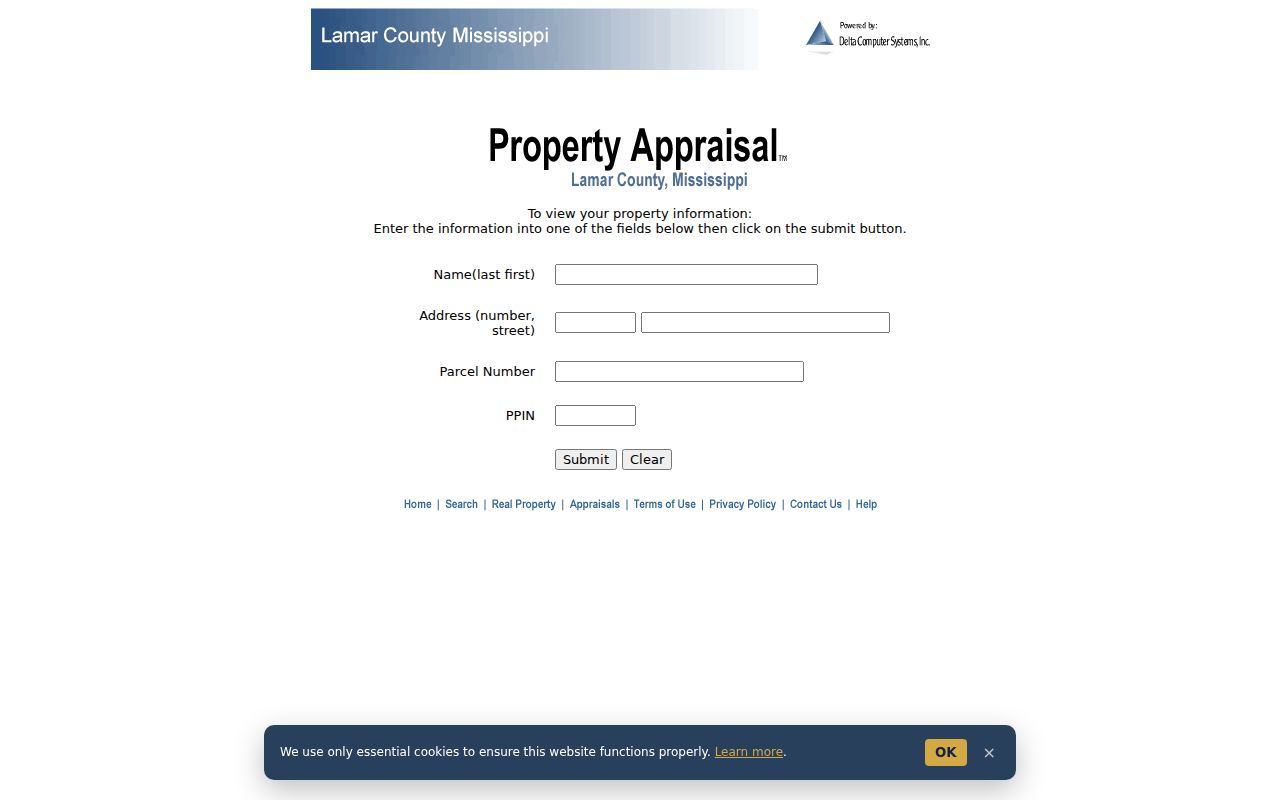
A blank search shell guarantees nothing about labels. Read the returned card before quoting an owner field. A closing after the snapshot can leave the prior roll name visible even though a newer deed has been recorded. The roll answers to its January 1 date, not to the deed book's latest page. Homestead data can support an ownership or occupancy inference. Still, it proves neither one on its own.
Note: Lamar County publishes no standard number of days between recording a deed and updating the Delta roll.
Separate Mailing From Situs
The mailing address is where the tax bill goes. It may point to an LLC office, a trustee, a bank, an out-of-county home, or a stale listing. The situs address is the physical parcel. Use it as the key for GIS maps, permits, flood, zoning, and adjacent-land work. A mismatch is only a clue. It does not prove the owner is absent, so confirm the person or entity with the recorded deed and any relevant official filing.
Verify Lamar Entity Owners
An LLC, trust, estate, trustee, executor, or life tenant may fill the owner line. Copy the name exactly. Search the deed index with punctuation variants, and run both the trust name and the trustee. For an estate, check the decedent and fiduciary. Look at executor, administrator, heirship, will, and decree records.
The Mississippi Secretary of State can confirm a business name, but its registered agent is only an entity contact, not proof that the agent owns the parcel.
Lamar's Official Index Wins
The Chancery portal states that its online index is informational. It may contain misspellings or incomplete indexing. The courthouse land index is the official one. An image, legal description, and recording date therefore carry more weight than a search-result name alone. Trust the recorded image over the index.
The Chancery Clerk accepts in-person review at the courthouse in Purvis. Copy requests go there too. Use that fallback when a name variant, a missing image, or a new filing blocks online confirmation.
Monitor Lamar Owner Changes
The Property Fraud Detection and Alert service monitors a person or company name and confirms contact by email or phone. It can flag a newly indexed name match. It cannot stop a recording or judge whether a deed is valid.
Compare each alert with the instrument number. Check the official image too. The name-based system may also alert on an unrelated person who shares the same name.
Handle a Recent Lamar Closing
A fresh closing calls for a dated, step-by-step check. Start with the roll's tax year and its January 1 effective date. Then find the newest conveyance for the same parcel or legal description. Compare execution and recording dates. They are not always the same day.
A new deed can outrank an older roll as evidence of the latest recorded transfer. Recording alone is no title opinion, though. Liens, probate orders, corrective instruments, and later filings can all matter. The Chancery portal itself warns that online indexing can be incomplete or misspelled.
When the online image is missing or the description unclear, contact the Chancery Clerk for courthouse review or a copy. That fallback matters most for a newly filed record. New filings take time to flow through every vendor system.
Use Lamar's Counter Fallback
Digital lookups break at the worst moments. An address may still carry an old road name. A deed may hide under a spelling variant. The newest filing may not yet sit in the vendor system. When that happens, go to the counter. The Tax Assessor/Collector can confirm the parcel, the PPIN, and the annual tax roll entry. Carry those details, plus the legal description and any deed reference, straight to the Chancery Clerk in Purvis.
That clerk holds the real depth of Lamar County property records. Direct and reverse indexes sit beside deed books, deed-of-trust volumes, and tax-sale and redemption files. Estates, homestead applications, and land cases in chancery court are there too. Run the name on both sides of a conveyance. One side alone can miss the match.
For the owner of record, chase the newest conveyance describing the same tract. Then look for a corrective deed, probate order, tax deed, or later instrument that might change the outcome. A copy request moves faster with precise identifiers: party names, instrument number, book and page, recording date, and the legal description. Request a certified copy whenever the document must serve as an official record. Remember that an online result is only a lead. The recorded image is evidence. Neither replaces a professional title opinion.
Older chains lead elsewhere. The MDAH Lamar County finding aid catalogs deed material tied to Marion County from 1836 through 1886. Its deed-book index reaches 1903. That archive rarely settles a recent owner question. It can, though, clarify an old source deed cited deep in the current chain.
Confirm Lamar's Current Owner
Confirming the current owner of a Lamar County parcel takes two steps. Join the tax roll to the most recent recorded deed through the parcel number and legal description. The name alone will not do.
- Search the appraisal roll by address and copy the owner, parcel or PPIN, situs, mailing, and legal-description clues.
- Use those keys in the Chancery deed index and locate the newest matching conveyance.
- Compare grantee, recording date, and land description. Read the image when available.
- If the grantee is an entity or estate, confirm its exact official name without treating an agent or fiduciary as the owner.
- Owner of record
- The party named on a record at its stated date.
- Assessment roll
- The county's annual property list for valuation and taxation.
- Recording lag
- The unquantified time between courthouse activity and an online roll update.
- Registered agent
- An entity's official service contact, not necessarily its landowner.
Use Lamar Owner Data Lawfully
A mailing address on the roll is a legitimate clue for property correspondence. Treat it as a mailing address, nothing more. It is not a home address or an invitation to visit. Mississippi's Address Confidentiality Program can substitute a protected mailing address. It covers qualifying victims.
The roll can lag. A newer recorded deed can be more current than the January 1 owner record. Neither source alone is a title opinion.
Put owner data to lawful uses. Sale inquiries, estate questions, fraud review, and boundary matters all qualify. Stalking, threats, trespass, and harassment never do, and public records offer no cover for them.
Keep your dates straight. Save the day you searched the tax roll. Save the filing date of the newest deed too. If the two name different parties, ask the Assessor whether a transfer is pending in the next roll update. Then ask the Chancery Clerk for the recorded instrument. Trust, estate, and life-estate language can split present rights. A short owner field never shows those splits. When the answer affects a transaction, let a title professional interpret those interests. A Mississippi attorney can do the same.